
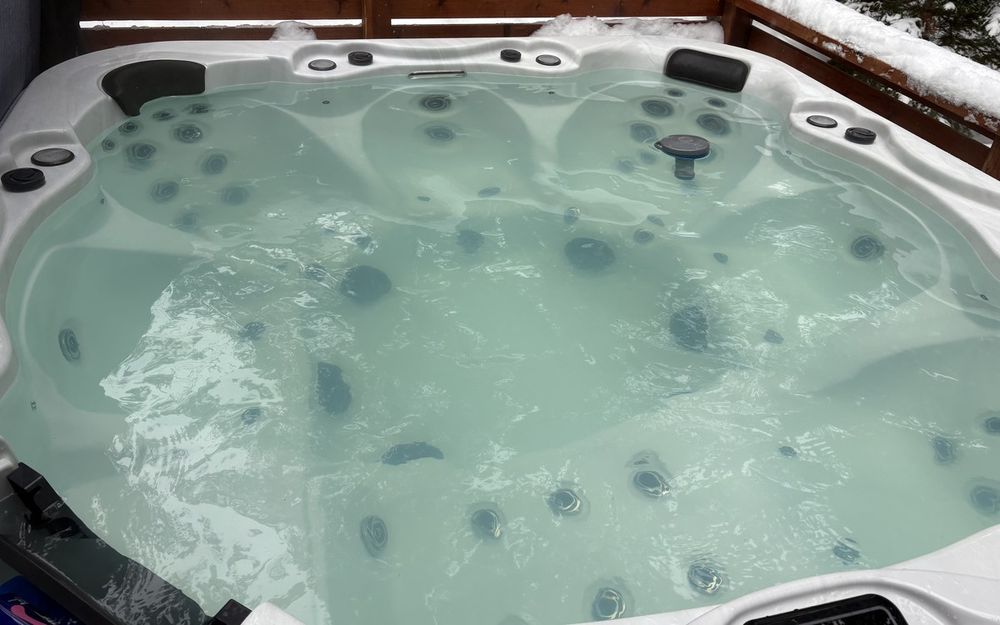
Why is my hot tub water cloudy?
If we had a dollar for every Monday-morning photo of hazy hot tub water, we could heat every spa in the county for free. Cloudy water is far and away the most common thing folks ask us about, usually after a weekend when the tub got more use than it's seen all month. The good news: it's almost always fixable, and once you understand what's actually happening, you can usually clear it up yourself.
Cloudy water isn't one problem. It's what a handful of different issues all look like on the surface. Here's how we sort through it.
Start with a test, not a guess
Before you add a single thing, test the water. Reaching for chemicals blind is the fastest way to turn a small cloud into a week-long mess. You're checking three numbers first:
- pH: you want roughly 7.2 to 7.8. High pH is a classic cloud-maker.
- Total alkalinity: around 80 to 120 ppm. Alkalinity is the shock absorber that keeps pH from bouncing around.
- Sanitizer: your chlorine or bromine needs to actually be present. After a busy weekend it's often been used up entirely.
Nine times out of ten, one of those three is off, and that's your answer.
The usual suspects
1. Sanitizer got overwhelmed
Every person who climbs in brings lotion, deodorant, sweat, and skin cells with them. A tub that's crystal clear for two people can turn milky after six. When the sanitizer gets used up faster than it can keep up, the water goes hazy. This is the number-one cause we see, especially at vacation rentals after a full house.
2. pH or alkalinity drifted
When pH climbs too high, minerals that were happily dissolved start to fall out of solution as tiny particles, and a million tiny particles is exactly what "cloudy" looks like. Rebalancing often clears things up on its own.
3. A tired filter
Your filter is doing the quiet work of pulling all that fine gunk out of the water. When it's clogged or just worn out, it stops keeping up. Pull it, rinse it, and take a good look. If it's been more than a year, it's probably due for replacement.
4. Hard water and minerals
This one's a little more local. A lot of our fill water up here is on the hard side, and our dry mountain air means water evaporates fast, which concentrates whatever minerals are left behind. Over months, that mineral load builds and water gets harder to keep clear no matter how perfectly you dose it.
5. The water's simply old
Every refill starts a clock. As water ages, dissolved solids build up to the point where fresh chemicals just can't get traction. If you're fighting the same haze week after week, the tub is usually trying to tell you it's time for fresh water.
How to clear it up
- Balance first. Get pH and alkalinity into range before anything else. Chemicals work far better in balanced water.
- Shock it. A proper dose of oxidizer burns off the organic gunk that sanitizer alone can't handle. Leave the cover off for a bit afterward so it can breathe.
- Run the jets and clean the filter. Circulation plus a clean filter is how the cloud actually gets removed. Give it a good rinse; if it's overdue, swap it.
- Give it a day. Most clouds clear within 24 to 48 hours once the chemistry is right and the filter is doing its job.
Keeping it clear
Clear water is mostly a rhythm: test a couple times a week, rinse the filter regularly, shock after heavy use, and refill on a sensible schedule instead of waiting for a problem. And if it keeps clouding up no matter what you try, there's usually a specific reason behind it: a tired filter, water that's overdue, or chemistry that keeps swinging. That's the kind of thing we sort out all day long across the county.