
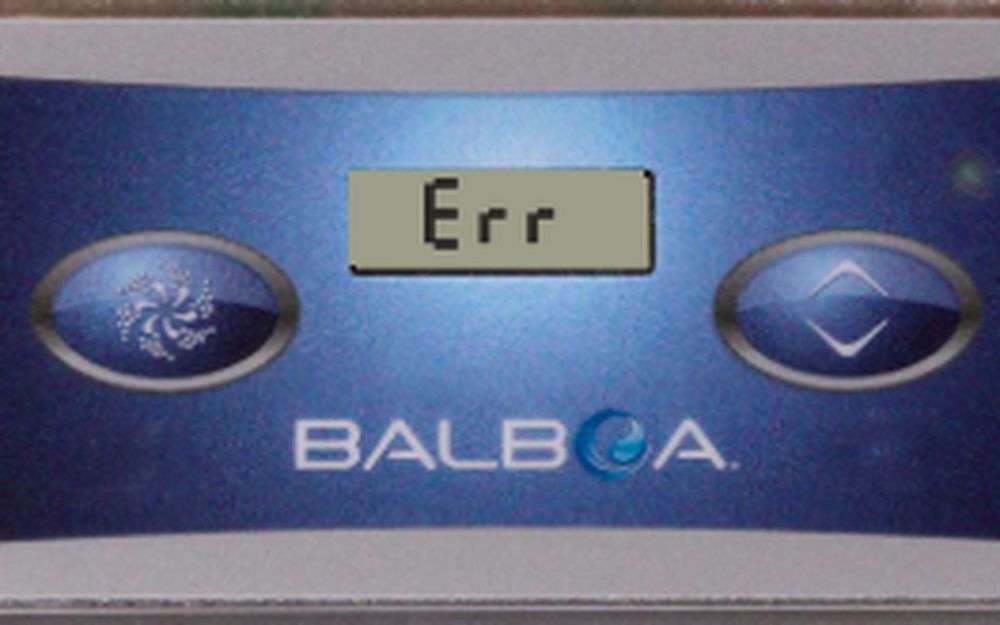
Common hot tub error codes, decoded
Your spa's display is smarter than people give it credit for, when something's off, it's usually trying to tell you exactly what's wrong. This is our plain-English guide to the codes we run into most often out in the field.
One thing up front: the exact letters vary by brand and control system. A Balboa pack, a Gecko system, and whatever's running your particular Bullfrog, Sundance, or Nordic may all spell the same problem a little differently. So treat this as a guide to the categories of trouble, not a guarantee of the precise characters on your panel. When you call us, the single most useful thing you can do is read us the exact code you're seeing.
Flow codes, the most common by far
Codes like FLO, FL, FL1, FL2, HFL, LF, or a flashing "flow" light all point to the same thing: the system isn't sensing proper water flow through the heater, so it's shutting the heater down to protect itself.
These are also the codes you're most likely to clear yourself, because the cause is usually simple:
- Dirty filter, by far the most common. Pull it, rinse it, test-run without it.
- Low water level, top off to mid-skimmer.
- Air lock, trapped air after a refill; the jets feel weak and the code appears.
- A closed or partly closed valve.
- A failing pump or a bad flow/pressure switch: this is the part that needs a technician.
Work the simple stuff first. If a clean filter, full water, and a bleed of the air don't clear it, the flow switch or pump is the likely suspect.
Temperature and overheat codes
Codes like OH, HH, OHH, OHS, or "overheat" mean the system read the water above a safe limit, often around 108–112°F, and shut the heater off as a safety measure.
What to do: take the cover off and let it cool down before you do anything else. Then think about why:
- A pump that's been running long hours can add heat on its own.
- A stuck or miscalibrated temperature sensor can report a false high.
- In rare cases the heater relay sticks on.
If it overheats again after cooling, don't keep resetting it; that's a sign something in the sensing or heating circuit needs a look.
On the other end, you may see COOL, COL, or "ICE"-type messages. Those usually aren't failures at all; see below.
Sensor codes
Codes like SN, Sn1, Sn3, SNA, SNB, dr, dry, or "sensor" indicate the control is unhappy with one of its temperature sensors, reading it as open, shorted, or out of range. Some "dr/dry" style codes specifically warn that the heater may be dry (no water around it), which ties back to flow.
Sensor faults are generally a technician job. The sensors themselves are inexpensive, but diagnosing which one and why takes the right tools. If you're getting a persistent sensor code, note it and give us a call rather than guessing.
Freeze and informational messages
Not everything on the display is bad news. Messages around freeze protection, "ICE," or SMART/economy modes are often the tub simply telling you what it's doing:
- A freeze-protection indicator usually means the spa detected cold conditions and turned the pumps on to keep water moving. That's your tub doing its job, a good thing on a Summit County night.
- Economy, sleep, or "rest" modes only heat during set windows. If your tub "won't heat," it may just be in one of these modes rather than standard/ready mode.
When to stop and call
Here's our rule of thumb. Flow codes and mode confusion are worth a DIY try: filter, water level, air lock, check the mode. But if you see any of these, hand it off:
- A code that returns immediately after every reset.
- Any breaker that trips as soon as you flip it back on.
- Overheat codes that come back after the tub has cooled.
- Sensor faults.
- Anything in deep winter cold, where a shutdown also means a freeze risk. Don't let that one sit.
We keep the common flow switches, sensors, and heater parts on the truck, so when it is one of the deeper issues, it's often sorted in a single visit. And if you're mid-code right now and not sure which bucket it falls in, just read us what the panel says. We can usually point you in the right direction over the phone.